
How to Grow Your Business in Malaysia After Market Entry: The Four Commercial Questions Every International Company Should Answer
Learn how to grow your business in Malaysia after market entry. Discover the four commercial questions every international company should answer before scaling successfully.
Bojamma
3 min read

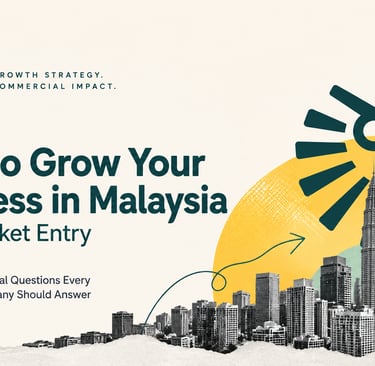
Expanding into Malaysia is a massive milestone for any international business. But entering a market and growing within it are two entirely different challenges.
Many companies spend months preparing for market entry. They navigate the legal setup, hire local talent, appoint distributors or partners, and finally launch. On paper, everything looks ready.
Then, a few months later, growth plateaus. More often than not, the problem isn't the product. And it isn't that Malaysia is the wrong market either. It's because market entry is an operational exercise, while business growth is a commercial one.
Growing your business in Malaysia isn't simply about launching faster or outspending the competition on marketing. It's about ensuring your commercial foundations are actually built for the local landscape. In my experience, companies that continue growing after market entry are usually the ones that answer four critical commercial questions early.
The Illusion of the Macro Numbers
Malaysia continues to be one of Southeast Asia's most attractive destinations for international expansion. In 2025, foreign direct investment (FDI) into Malaysia grew by 41.2%, reaching RM65.9 billion. That momentum carried straight into 2026, with RM92.8 billion in approved investments across 1,249 projects in the first quarter alone.*
These figures reinforce Malaysia's position as a powerhouse strategic hub for companies looking to expand across the region. What these numbers don't tell us, however, is what happens after the ribbon-cutting ceremony.
Some businesses scale year after year. Others struggle to gain commercial traction despite having a proven product and a successful track record elsewhere. The difference often isn't the quality of the product or the size of the marketing budget. It's whether the business has answered four commercial questions that are easy to overlook during expansion but impossible to ignore once growth begins to flatten.
The 4 Commercial Steps to Post-Entry Growth
1. Demand Validation: Are We Solving a Problem Malaysian Customers Actually Prioritize?
Many international companies assume that if a product succeeds in one market, the same demand exists in Malaysia. That isn't always true.
Customer priorities, buying behaviour and decision-making processes can differ significantly from one market to another. The question isn't whether your product works. It's whether it solves a high-priority, urgent pain point that Malaysian customers are actively looking to solve today. If that assumption hasn't been validated locally, every commercial decision that follows becomes significantly harder.
2. Positioning Fit: Does Our Value Proposition Resonate With Local Buyers?
A strong product doesn't automatically translate into a strong value proposition.
The message that won customers elsewhere may not be the message that convinces buyers in Malaysia. What customers value, the proof they expect and the objections they raise often vary from market to market. Before investing further into growth, ask yourself one question. Has your positioning been validated for Malaysian buyers, or has it simply been copied and pasted from another market?
3. Engine Viability: Can We Acquire Customers Consistently and Profitably?
Acquiring your first customers through existing relationships, referrals or initial launch activities is relatively straightforward. The bigger challenge is building a repeatable customer acquisition engine that remains commercially viable as the business grows.
If growth relies on one-off opportunities or marketing spend that becomes increasingly expensive over time, scaling becomes much harder. The question isn't whether you're acquiring customers today. It's whether you can continue doing so consistently and profitably over the long term.
4. Growth Sustainability: Can We Retain Those Customers Long Enough to Build a Sustainable Business?
Winning your first customer is only the beginning. Long-term growth depends entirely on what happens after that first sale.
Are customers coming back? Are they renewing? Or are you spending more time replacing churned customers than growing your total customer base? Retention is often one of the clearest indicators that you've built a sustainable business rather than simply generated initial, short-lived demand.
Where a Local Growth Partner Makes the Difference
These four questions are difficult to answer accurately without local commercial context. That's where a local growth partner adds distinct value. Not by replacing your internal team, but by helping you validate assumptions, identify commercial blind spots, and build a growth strategy that is grounded in how the Malaysian market actually behaves.
Entering the Malaysian market gets your business into the market. Building a localized commercial engine is what keeps it there.
How The Morning Owl Helps International Companies Grow in Malaysia
At The Morning Owl, we partner with international companies that have already decided Malaysia is the right market but need a clearer path to commercial growth. Rather than focusing solely on marketing execution, we help businesses validate their growth strategy, identify commercial bottlenecks and uncover opportunities across the customer journey, from acquisition and activation to retention and revenue growth.
Whether you're preparing for market entry or looking to accelerate growth after launch, our role is to help you answer the commercial questions that matter most, so your expansion into Malaysia becomes more than just a successful launch. It becomes a sustainable business.
*References
The Morning Owl SDN. BHD.
(202501015530 / 1616945-K)