
The Complete Guide to Diagnosing Checkout Abandonment: Why Customers Reach Checkout But Don't Pay
A diagnostic guide to checkout abandonment. Instead of generic fixes like discounts and cart emails, it breaks abandonment into five commercial causes, including decision friction, commitment anxiety, pricing anxiety, lack of urgency and trust gaps, with the behavioural signals that identify each one and the questions to ask before optimising anything.
6 min read
Someone added your product to cart, started checkout, typed in their details, and then left.
Most businesses immediately call this cart abandonment, and then they start fixing the wrong things. They redesign the checkout page, add discounts, install exit-intent popups, send abandoned cart emails, offer free shipping. Sometimes it works. Most of the time it doesn't, and not because those tactics are bad. It's because they were treating the symptom instead of diagnosing the cause.
Businesses see one metric, but behind that one metric could be five completely different commercial problems. If you don't know which one you're dealing with, every optimisation becomes a guess.
Cart Abandonment Is a Symptom, Not a Diagnosis
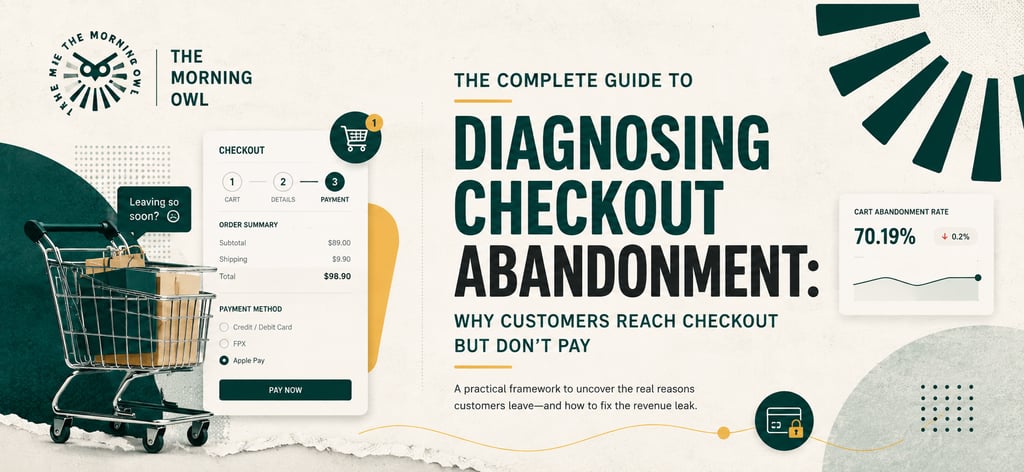
One of the most quoted statistics in e-commerce is that around 70% of online shopping carts are abandoned before purchase. According to the Baymard Institute's ongoing research, the average documented cart abandonment rate sits at 70.19% across industries.
That number sounds alarming, but it also creates a dangerous assumption: it makes businesses believe that everyone who abandoned checkout behaved the same way. They didn't.
One customer leaves because they don't trust you. Another because your checkout takes too long. Another because they need approval from their spouse. Another because Apple Pay isn't available. Another because they wanted to compare competitors first. All of them become one number inside your dashboard.
That's why "reduce cart abandonment" is too broad to be useful. The better question is this: why did this particular customer stop buying after deciding they wanted the product? That's where commercial diagnosis begins.
What Actually Happens Between "I Want This" and "I'll Pay for This"
Many people think checkout is simply a payment page. It isn't. It's the final decision-making stage.
Up until checkout, the customer is evaluating your product. Inside checkout, they're evaluating the purchase. Those are two different decisions.
A customer can completely believe your software solves their problem and still hesitate to spend $299. They can love your skincare product and still wonder whether to wait for payday. They can be convinced your service is the best on the market, and leave because FPX isn't available.
Nothing changed about your product. The purchase environment changed. That distinction matters.
The Five Commercial Diagnoses Behind Checkout Abandonment
1. Decision Friction
This is probably the most misunderstood cause. Decision friction happens when customers have already decided they want to buy, but the buying process becomes harder than expected. It isn't always one major issue; sometimes it's dozens of tiny interruptions adding up.
Examples include too many checkout steps, mandatory account creation, long forms, slow page loading, limited payment methods, unexpected shipping calculations, and mobile checkout that's difficult to use.
Baymard's checkout usability research consistently shows that unnecessary friction remains one of the biggest contributors to abandoned purchases.
The important thing to notice here is that these customers didn't reject your product. They rejected the experience of buying it.
Behaviour you'll notice: fast abandonment, high mobile drop-off, high exit rates after shipping details, high payment page exits, rage clicking, and repeated form validation errors.
What businesses usually assume: "our product isn't attractive enough."
What's actually happening: the customer got tired, or confused, or interrupted.
2. Commitment Anxiety
This one is psychological. The customer wants the product, and then the money becomes real.
Until checkout, buying is hypothetical. The moment the payment screen appears, commitment becomes permanent, and that's when the thoughts begin: "maybe later," "I should compare another option," "what if I don't use it?", "is this really worth $299?"
Notice something: none of those questions existed when they first discovered your business. Checkout didn't create uncertainty. It exposed uncertainty that already existed.
This is especially common in SaaS subscriptions, annual memberships, high-ticket coaching, premium consumer products, and B2B software.
Behaviour you'll notice: multiple visits before purchasing, several pricing page visits, long session durations, returning days later, comparing competitors.
The common mistake: businesses immediately reduce prices. But the issue often isn't affordability. It's confidence.
3. Pricing Anxiety
Pricing anxiety is different from commitment anxiety. Commitment anxiety asks "should I buy?" Pricing anxiety asks "is this worth paying for?" They're not the same.
A customer might fully intend to buy, and then they see $59 shipping, taxes, service charges, and platform fees. Suddenly the value equation changes.
Research consistently shows that unexpected extra costs remain one of the biggest reasons shoppers abandon purchases. Baymard's longitudinal checkout research found that extra costs are repeatedly among the most cited reasons customers leave before completing payment.
Behaviour you'll notice: coupon searching, opening discount tabs mid-checkout, leaving after the shipping calculation, switching to cheaper plans, removing products from the cart.
The business mistake: offering bigger discounts. Often the better question is why the value wasn't obvious before the price became final.
4. No Urgency
This one is deceptively simple. The customer intends to buy, just not today. Tomorrow becomes next week, and next week becomes never.
Behavioural economists have long documented present bias, the tendency for people to delay actions that don't feel immediately necessary. Without a meaningful reason to act now, procrastination becomes the default decision.
Note that this doesn't require fake countdown timers or artificial scarcity. Real urgency comes from genuine stock limitations, expiring offers, seasonal demand, upcoming events, business deadlines, and product launches.
Behaviour you'll notice: high returning visitor rates, multiple saved carts, very long purchase windows.
The mistake businesses make: creating fake urgency. Customers recognise it surprisingly quickly.
5. Trust Gaps
Trust isn't built only on your homepage. It has to survive checkout.
A customer might reach the payment page and suddenly realise they still don't know how returns work, when delivery happens, whether payment is secure, whether support exists, or whether they'll regret buying.
Small trust signals matter, and security badges alone won't fix poor credibility. Trust comes from reducing uncertainty: a clear refund policy, real customer reviews, transparent shipping information, visible contact details, obvious business legitimacy, and simple guarantees.
Behaviour you'll notice: long checkout times, leaving payment pages, visiting the FAQ before purchasing, searching for reviews.
Don't Guess. Diagnose.
Here's a simple framework:
Leaves immediately after checkout starts → Decision Friction
Revisits pricing multiple times → Commitment Anxiety
Searches for coupon codes → Pricing Anxiety
Returns several days later → No Urgency
Visits reviews or FAQ before paying → Trust Gap
Notice that none of these customers need exactly the same solution. Yet many businesses give all of them the same three things: a 10% discount, an abandoned cart email, and free shipping. Sometimes those work. Often they simply hide the underlying issue.
The Cost of Misdiagnosis
Imagine your checkout converts at 2%. You decide to increase advertising, traffic doubles, and sales barely move.
Marketing wasn't broken. Checkout was. You've now paid to send twice as many people into the same leak.
This is why commercial diagnosis matters. Fixing acquisition before fixing conversion often makes expensive problems bigger.
Questions Every Business Should Ask Before Optimizing Checkout
Instead of asking "how do we reduce cart abandonment?", ask:
Where exactly are people leaving?
What happens immediately before they leave?
Is there a behavioral pattern?
Is it mobile only?
Is it one payment method?
Is it one product?
Is it after shipping costs are shown?
Is it after pricing?
Those questions move you closer to diagnosis, and diagnosis determines optimization.
Final Thought
Most businesses don't have a checkout problem. They have a diagnosis problem.
When everyone who leaves gets grouped into one metric, every solution starts looking the same. But customers don't abandon checkout for one reason. They leave because different commercial, behavioural, technical and psychological factors surface at the final moment of decision.
The businesses that improve conversion the fastest aren't necessarily the ones running the most experiments. They're the ones asking better questions before they change anything.
How The Morning Owl Helps
At The Morning Owl, we don't start by recommending checkout redesigns, discount campaigns or CRO tactics. We start by diagnosing why customers are leaving.
That means understanding where the buying decision breaks down, whether the issue is decision friction, pricing, trust, customer psychology or something else entirely. Only once the diagnosis is clear do we recommend experiments designed to fix the real revenue leak, not just improve a metric.
Frequently Asked Questions
What is checkout abandonment?
Checkout abandonment happens when a customer begins the checkout process but leaves before completing payment.
Is cart abandonment always bad?
No. Some customers are researching, comparing prices or saving items for later. The goal isn't to eliminate abandonment entirely, but to understand why it happens.
What's the difference between cart abandonment and checkout abandonment?
Cart abandonment includes anyone who adds a product to their cart but doesn't buy. Checkout abandonment is a narrower stage where the customer has already started entering purchase details, which makes it a much stronger signal of buying intent.
Should every business send abandoned cart emails?
Not necessarily. If the underlying issue is payment friction, unexpected costs or trust, reminder emails won't address the real problem.
Sources
Nielsen Norman Group – Shopping Carts, Checkout & Registration research
Behavioural economics research on present bias and decision-making by Richard Thaler and related academic literature
The Morning Owl SDN. BHD.
(202501015530 / 1616945-K)