
Where Revenue Leaks Happen: The Five Areas That Slow Business Growth
Bojamma
5 min read
Revenue growth rarely slows because of a single event. Most businesses do not wake up one morning and find they lost half their customers.
Instead, growth slows gradually: Conversion rates decline, customer acquisition costs increase, customers stop returning as often, revenue per customer falls, and a few more users abandon onboarding than before. Individually, these changes seem small, but together they create a major impact on business performance.
The challenge is that most businesses focus on the symptom rather than the source. When revenue slows, the immediate response is often to generate more leads, increase advertising spend, or launch new campaigns. Sometimes that works. More often, the real issue already exists somewhere within the customer journey.
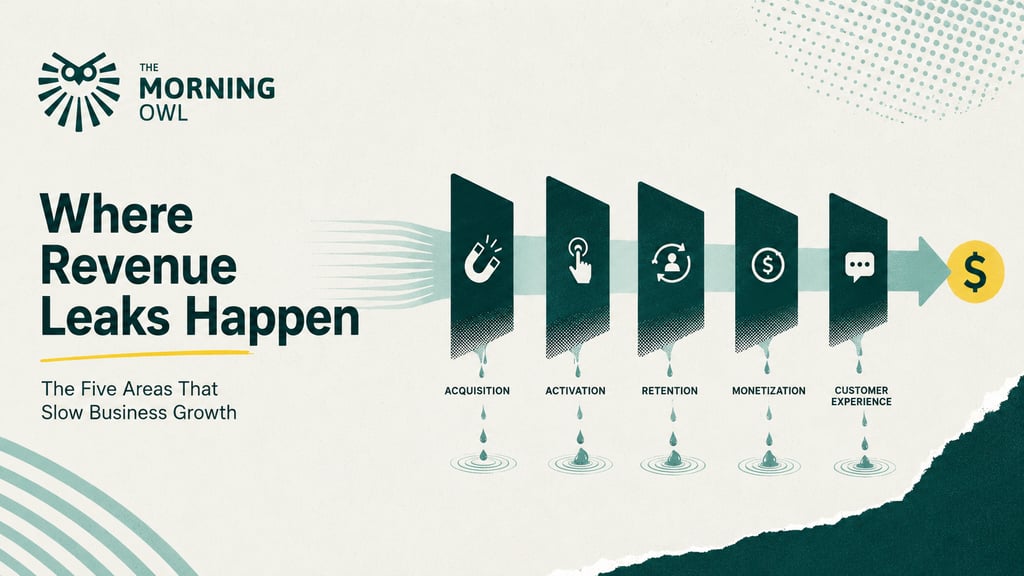
In our experience, revenue leaks typically occur in one of five areas:
Acquisition
Activation
Retention
Monetization
Customer Experience
Understanding which area is underperforming is the difference between sustainable growth and continuously spending more to achieve the same result.
1. Acquisition: More Leads Does Not Always Mean More Revenue
When growth slows, acquisition is usually the first area businesses investigate. The logic seems straightforward: if revenue is down, you need more customers. This often leads to larger advertising budgets, more campaigns, and a greater focus on lead generation.
The problem is that more leads do not automatically create more revenue. Many businesses generate a healthy volume of enquiries, website traffic, or app installs but struggle to convert those prospects into paying customers.
In these situations, the issue is rarely quantity. It is quality. A business attracting the wrong audience will see rising customer acquisition costs, low conversion rates, and poor customer retention. Even if lead volume increases, revenue may remain unchanged because the people entering the funnel were never likely to buy.
Instead of asking how to generate more leads, businesses should first ask whether they are attracting the right customers.
Common signs of an Acquisition problem:
Rising Customer Acquisition Cost (CAC) while revenue stays flat
High website traffic but low sales conversion rates
Large numbers of leads that sales teams cannot convert
App installs with little post-download engagement
2. Activation: Customers Never Experience The Value
Many businesses successfully acquire customers but fail to activate them. Activation occurs when a customer experiences the value of a product, service, or business for the first time.
For a SaaS platform, it means successfully setting up an account and using a key feature.
For a mobile app, it means completing onboarding and using the tool.
For an e-commerce business, it means completing a first purchase.
For a service business, it means moving from an enquiry to a confirmed project.
The challenge is that many customers never reach this point. They sign up, install the app, request a demo, or make an enquiry, but never progress further. As a result, businesses often assume they have a retention problem when the real issue is activation.
Customers rarely stay if they never experienced enough value to begin with. Improving activation helps customer retention because it fixes the exact point where users drop off for the first time.
Common signs of an Activation problem:
High drop-off rates during the onboarding process
Users logging into a platform once and never returning
A long timeline before a customer sees a result
Accounts that remain open but sit completely idle
3. Retention: Customers Leave Earlier Than You Think
Customer acquisition tends to receive most of the attention, but customer retention determines whether growth is sustainable.
Many businesses focus heavily on bringing in new customers while spending far less effort understanding why existing customers leave. This creates a costly cycle where customers are acquired, leave, and must be replaced. As customer acquisition costs continue to rise across most industries, replacing lost customers becomes increasingly expensive.
Consider two businesses acquiring customers at the same cost. If one retains customers for twelve months while the other retains them for six, the business with stronger retention will generate double the value from every customer acquired.
Retention problems often develop quietly. By the time revenue reflects the issue, the root cause may have existed for months. This is why businesses should monitor retention metrics just as closely as acquisition metrics.
Common signs of a Retention problem:
Falling repeat purchase rates
Reduced customer engagement or lower product usage
Increasing cancellation rates
Declining contract renewal rates
4. Monetization: You Are Not Maximizing Existing Customers
Not every growth challenge requires more customers. Sometimes the greatest opportunity already exists within the customers a business has today.
Monetization refers to how effectively a business generates revenue from existing customer relationships. This includes pricing, product adoption, repeat purchases, upselling, and cross-selling.
Many businesses focus on acquiring additional customers before maximizing the value of existing ones. For example, a business with 1,000 customers generating RM100 each behaves very differently from a business with 1,000 customers generating RM300 each. The customer count is identical. The revenue outcome is not.
When customer lifetime value increases, acquisition becomes more efficient because each customer generates greater returns over time. The most valuable customer is often not the next one. It is the one you already have.
Common signs of a Monetization problem:
Stagnant average order value over time
Pricing structures that have not changed as the product improved
Low adoption rates for premium tiers or add-on services
Customer lifetime value that is too close to your acquisition costs
5. Customer Experience: Small Frictions Create Large Revenue Losses
Customer experience influences every stage of the customer journey. It affects whether customers convert, whether they stay, and whether they return.
Unlike acquisition or retention, customer experience issues are often spread across multiple touchpoints. A website may be difficult to navigate. Forms may be too long. Onboarding may be confusing. Customer support may be slow to respond.
Individually, these issues may appear minor. Collectively, they create friction. Friction reduces conversion rates, weakens activation, lowers retention, and limits customer lifetime value.
Customers rarely explain every reason they choose not to move forward. Most simply leave. This is why customer experience is a business performance issue that directly impacts revenue. Small improvements throughout the customer journey often produce measurable improvements in overall business growth.
Common signs of a Customer Experience problem:
High shopping cart or application form abandonment rates
A high volume of support tickets regarding basic tasks
Negative customer reviews or dropping customer satisfaction scores
High drop-offs at specific transaction points like checkout or signing contracts
The Cost Of Fixing The Wrong Problem
One of the most common mistakes businesses make is assuming they already know where the leak exists without analyzing the data.
Revenue slows, so they invest more in advertising. Customers leave, so they launch a loyalty programme. Conversions decline, so they redesign the website. Sometimes these actions help. Sometimes they simply make an expensive problem more expensive.
A retention problem can appear to be an acquisition problem. An activation problem can look like a retention problem. A customer experience issue can feel like a marketing problem.
Without identifying the true bottleneck, businesses risk investing time and money in solutions that fail to address the underlying cause. The goal is not to fix everything at once. The goal is to identify the problem with the greatest impact on revenue and address it first.
Final Thoughts
Most businesses do not have a revenue problem. They have a visibility problem. They can see the symptoms, but they cannot see the leak.
Revenue growth depends on how effectively a business acquires customers, activates them, retains them, monetizes them, and supports them throughout the customer journey. When one area underperforms, growth slows.
The businesses that grow most efficiently are not always the ones spending the most on acquisition. They are usually the ones that identify the bottleneck first and fix it before investing further. The fastest way to improve revenue is not always finding more customers. Sometimes it is keeping more of the revenue you are already earning.
At The Morning Owl (TMO), we help businesses identify where revenue is leaking across acquisition, activation, retention, customer lifetime value, and customer experience, then build practical strategies to improve growth performance. Because before revenue can grow, the leaks need to be fixed.
The Morning Owl SDN. BHD.
(202501015530 / 1616945-K)