
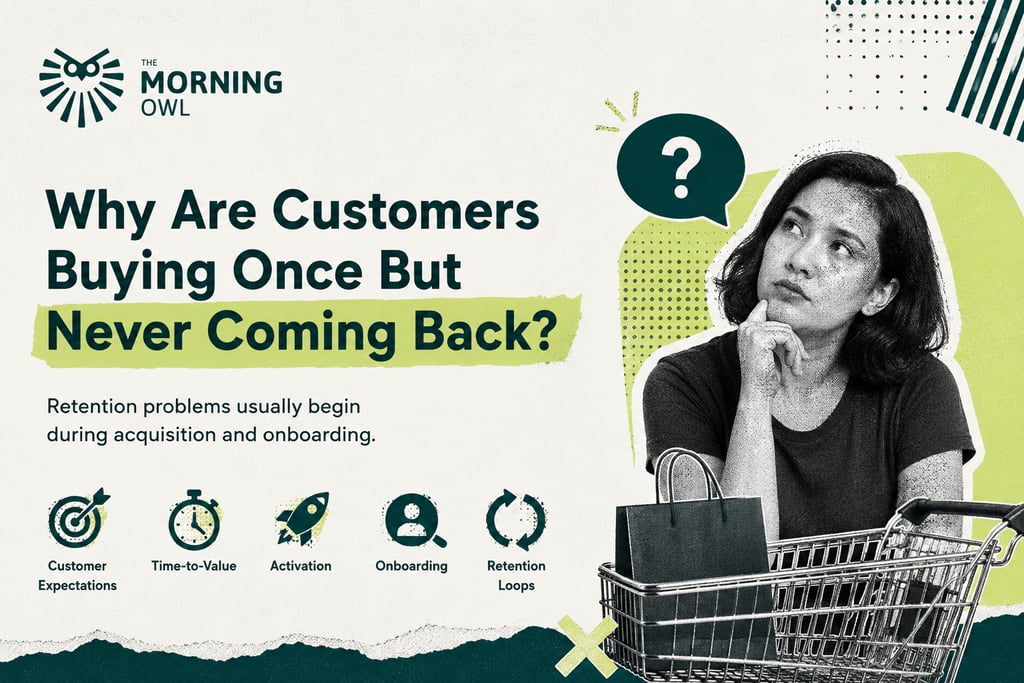
Why Are Customers Buying Once But Never Coming Back?
Customers who buy once and never return often signal deeper problems in acquisition, onboarding, activation, and time-to-value. Learn what causes poor customer retention and how to fix it.
Bojamma
4 min read
Getting a customer to make their first purchase is often treated as the finish line. In reality, it's only the beginning.
Many businesses focus heavily on acquisition. They invest in advertising, SEO, social media, lead generation, and conversion optimisation to attract new customers. The result is often a healthy stream of first-time buyers. Despite growing customer numbers, revenue growth remains inconsistent. Repeat purchases stay low. Customer lifetime value struggles to improve. Retention rates fail to meet expectations.
When this happens, most companies assume they have a retention problem. Often, they don't. They have an acquisition and onboarding problem that is showing up as a retention problem.
The Retention Mistake Most Businesses Make
Retention is commonly viewed as something that happens after a customer buys. Tactics like email campaigns, Discount offers, Membership benefits, and promotional offers can help, but they rarely fix the root cause.
Customer retention starts long before a second purchase decision is made. It begins with the expectations created during acquisition and the experience delivered immediately after the first purchase.
If those two things are misaligned, customers leave before a retention strategy ever has a chance to work.
Why Customers Buy Once And Never Return
While every industry is different, most one-time customer behavior can be traced back to five common issues.
1. The Customer Didn't Receive The Value They Expected
Every advertisement, social post, landing page, sales conversation, and promotion creates expectations. Customers don't evaluate your business based on what you intended to communicate.
They evaluate it based on what they expected to receive. If your messaging promises convenience but the experience feels complicated, trust declines. If your marketing highlights premium quality but the product feels average, disappointment follows. If your acquisition strategy attracts the wrong audience entirely, retention becomes almost impossible.
The gap between expectation and reality is often the first point where retention breaks.
2. Time-To-Value Is Too Slow
One of the strongest predictors of long-term retention is how quickly customers experience meaningful value. This concept is commonly known as Time-to-Value. The faster customers achieve the outcome they were hoping for, the more likely they are to stay.
For a SaaS platform, this could mean completing a key workflow within the first day. For an e-commerce brand, it could mean receiving a product quickly and having a positive first-use experience. For a fitness app, it might be helping users complete their first workout within minutes of signing up.
The longer customers wait to experience value, the higher the risk of abandonment.
3. Customers Complete A Transaction But Never Become Activated
A purchase does not automatically create a customer relationship. Many businesses celebrate conversions while overlooking activation. Activation occurs when a customer takes the first meaningful action that demonstrates they are receiving value from what they purchased.
Examples include:
Completing onboarding
Using a product successfully
Booking a second appointment
Making a second order
Engaging with a key feature
Achieving an initial outcome
Without activation, many customers remain one-time buyers regardless of how much was spent acquiring them. Many activation failures are actually onboarding failures. If customers don't know how to get value quickly, they are unlikely to return.
Understanding the difference between a customer and an activated customer is critical because activation is often the bridge between acquisition and retention.
4. Customers Never Form A Habit
Retention becomes much easier when customers build a habit around your product or service. The challenge is that many businesses focus on generating the first purchase without creating a reason for the second.
A customer may enjoy the experience, leave satisfied, and still never return. Not because they're unhappy but your business never became part of their routine.
This is common across industries:
SaaS users who never incorporate the product into their workflow
E-commerce customers who buy a product that doesn't require replenishment
Fitness app users who complete one workout and stop
Hospitality guests who have a pleasant stay but no reason to book again
Satisfaction alone does not create retention, repeated value does. The strongest businesses create experiences that naturally encourage customers to return, engage, or purchase again.
5. There Is No Clear Path To The Next Interaction
Many businesses work extremely hard to acquire a customer and then provide no guidance on what happens next. The customer completes a purchase, the transaction ends and the communication stops. Without a clear next step, engagement often fades. Customers should never have to guess what to do after experiencing value.
Whether it's a second purchase, another booking, a key product feature, or a follow-up action, businesses that retain customers well make the next step obvious. Retention is rarely a decision with single factor.
It's a series of small actions that keep customers moving forward.
Building Retention Loops Instead Of One-Time Transactions
The strongest businesses don't rely on customers remembering to come back. They create retention loops. A Retention loop is a system where receiving value naturally increases the likelihood of future engagement.
Examples include:
Productivity software that becomes embedded in daily workflows
Food delivery apps that learn customer preferences over time
E-commerce brands that create replenishment habits
Healthcare providers that establish ongoing care journeys
Hospitality businesses that personalize future experiences
The goal is to create a reason for the next interaction that goes beyond first purchase. Every positive experience should make the next experience more likely.
Questions To Ask If Customers Aren't Returning
If repeat purchases are lower than expected, start by asking:
Are we attracting the right customers?
Are our marketing messages creating unrealistic expectations?
How quickly do customers experience value?
What percentage of customers become activated?
Where do customers drop off during onboarding?
What behaviour typically happens before a repeat purchase?
Do customers have a clear reason to return?
What happens immediately after the first purchase?
The answers often reveal that retention issues began much earlier in the customer journey.
How TMO Helps Improve Customer Retention
At TMO, we believe retention is rarely a standalone problem.
Low repeat purchases, declining engagement, and customer churn often originate much earlier in the customer journey. The root cause may be misaligned acquisition campaigns, weak onboarding experiences, slow time-to-value, poor activation rates, or gaps between customer expectations and reality.
Our approach focuses on identifying where customers disengage across the entire journey, from acquisition and onboarding through to activation, retention, and revenue. By understanding where value delivery breaks down, businesses can improve retention without relying solely on discounts or promotions.
The objective is simple: help more customers experience value, return more often, and generate greater customer lifetime value.
Final Thoughts
Customers rarely disappear without a reason. Most businesses simply discover the problem too late. By the time retention metrics decline, the real issue has often already occurred during acquisition, onboarding, or activation.
Improving retention is not just about keeping customers.
It is about creating an experience that consistently delivers value, builds confidence, and gives customers a reason to return. Businesses that understand this stop treating retention as a post-purchase function. They recognise it as a system that starts from the very first interaction.
The Morning Owl SDN. BHD.
(202501015530 / 1616945-K)