
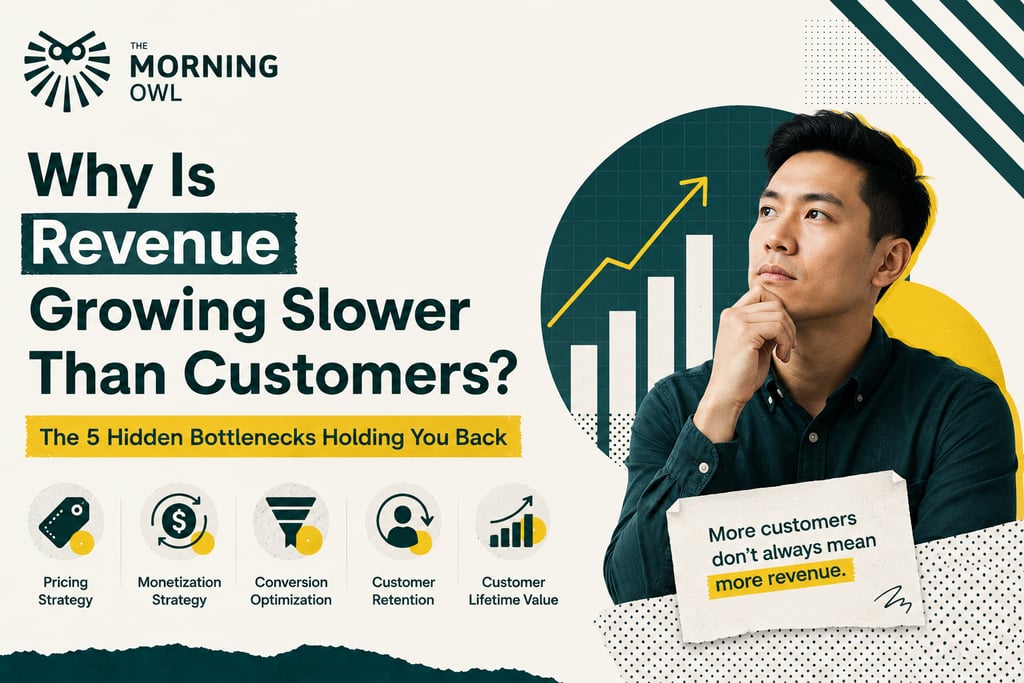
Why Is Revenue Growing Slower Than Customers?
More customers don't always translate into more revenue. This article explores the five hidden bottlenecks that often cause revenue growth to lag behind customer growth and how to identify where value is leaking in your business.
Bojamma
5 min read
Over the past year, an uncomfortable trend has emerged across mid-sized businesses and scaling brands. Traffic is up, Sign-ups are steady, Customer acquisition numbers look great while net revenue isn't matching that growth curve.
If more people are buying from you, shouldn't you be making more money? Not anymore.
In the current market, customer growth and revenue growth have decoupled because of AI-driven search, algorithmic discovery, and fragmented marketing channels; getting attention has actually become easier. But translating that initial attention into sustainable, compounding dollars is a completely different challenge.
When revenue lags behind customer volume, the bottleneck often sits somewhere beyond acquisition. More often than not, it points to a structural revenue leak hidden within the business.
The challenge is that these leaks rarely show up in a marketing dashboard. They sit inside pricing decisions, monetization models, conversion journeys, retention performance, and customer value. As customer numbers continue to grow, those issues can remain hidden for months before they begin affecting revenue in a meaningful way.
Beyond Acquisition: The 5 Growth Bottlenecks
When revenue growth slows down, the knee-jerk reaction is to spend more on marketing. But injecting more budget into a leaking funnel just wastes capital.
If your customer base is growing but your revenue isn't, the issue often lies in one of five areas.
1. Stagnant Pricing Strategy
The pricing model that secured your first thousand customers is rarely the one that will get you to the next stage of growth. Buyers today use AI tools, search engines, review platforms, and aggregators to compare options instantly. If you haven't evolved your product pricing strategy or reassessed whether your pricing reflects the value you're delivering, you may be leaving revenue on the table with every new customer you acquire.
The issue isn't always charging more; sometimes it's about understanding whether your business is capturing value effectively as customer expectations, competition, and market conditions change.
This is why conversations around Pricing Strategy, Pricing Optimization, Value-Based Pricing, and Pricing Psychology have become increasingly important for growing businesses.
2. Under-Optimized Monetization
A surge of new customers can easily mask an inefficient monetization strategy. Many businesses focus heavily on customer acquisition but spend far less time evaluating what happens after the first transaction.
If your team works hard to acquire a customer but has no clear path for expansion revenue through upgrades, add-ons, cross-sells, subscriptions, or premium offerings, growth eventually plateaus. Sustainable growth requires a revenue model that scales beyond the initial sale.
The businesses pulling ahead are often not the ones attracting the most customers but the ones continuously improving how they monetize demand after acquisition.
3. Funnel Conversion Leaks
Conversion Rate Optimization (CRO) is often associated with landing pages and website forms but true conversion happens throughout the customer journey.
A visitor becomes a lead → A lead becomes a customer →A customer becomes a repeat customer → A repeat customer becomes a loyal customer.
Small inefficiencies across those stages compound over time, like a slightly weaker onboarding experience, a confusing checkout process, or even a poorly timed upgrade prompt.
Individually, these may seem insignificant. Collectively, they can create substantial revenue leakage.
This is why Conversion Optimization, Conversion Funnel Optimization, Landing Page Optimization, Website Conversion Improvement, and A/B Testing remain critical components of a broader Revenue Optimization Strategy.
4. Poor Customer Retention
If you're onboarding 30% more customers but revenue only grows by 10%, you may have a retention issue disguised as an acquisition success. Acquiring a customer is expensive which is only recovered when customers stay long enough to generate meaningful value.
Without a structured Customer Retention Strategy, businesses often find themselves trapped in a cycle of constantly replacing customers who quietly leave, resulting in growth on paper but limited progress in actual revenue performance.
Many businesses don't realize they have a retention problem because acquisition metrics continue looking healthy. By the time retention becomes obvious, significant revenue has already been lost.
5. Declining Customer Lifetime Value (CLV)
One of the most common reasons revenue grows more slowly than customers is declining Customer Lifetime Value.
Customer volume may look healthy; Revenue may continue to increase, but the value generated from each customer gradually decreases. Customers buy once and never return or they choose lower-value offerings or they fail to upgrade. They disengage earlier than previous customer cohorts.
Over time, growth becomes increasingly dependent on acquiring larger volumes of new customers just to maintain the momentum. This is why Customer Lifetime Value, CLV Optimization, LTV Optimization, and Customer Value Growth have become key priorities for businesses focused on long-term revenue performance.
How to Diagnose Your Specific Revenue Leak
The challenge is that these five levers rarely operate independently: A pricing issue can look like a conversion problem. A monetization weakness can look like an acquisition problem. A retention challenge can quietly erode Customer Lifetime Value.
To identify where momentum is being lost, start by asking these questions:
The Value Shift: Has the average revenue generated per customer segment changed over the past nine months?
The Scale Test: Does our pricing structure scale as customers extract more value from our product or service?
The Expansion Metric: What percentage of revenue comes from upsells, upgrades, renewals, or expansion versus net-new customers?
The Cohort Check: Are our newest customer cohorts staying longer or leaving sooner than previous cohorts?
The Drop-Off Point: Where does the largest decline occur in our customer journey—before the first purchase or before the second?
The answers often reveal opportunities that aren't immediately visible in acquisition dashboards.
The Shift to Revenue Efficiency
For years, growth teams were rewarded for generating more: More traffic, more leads, more customers, and more users.
And for a long time, that worked. But in today's market, customer acquisition is becoming increasingly accessible. AI-driven discovery, recommendation engines, marketplaces, performance advertising, and content platforms have created more ways than ever to get in front of potential buyers.
The challenge is that attention is no longer the scarce resource. Revenue efficiency is.
The businesses pulling ahead in 2026 are often not the ones attracting the most customers. They are the ones extracting the most value from every customer they already have.
They understand which customer segments generate the highest lifetime value. They know where customers drop out of the funnel. They continuously refine pricing, monetization, and retention instead of relying solely on acquisition to fuel growth.
As a result, many leadership teams are shifting the conversation away from customer volume and toward questions such as:
How much revenue does each customer generate?
How quickly are acquisition costs recovered?
Are customers becoming more valuable over time?
Which growth activities are creating sustainable revenue?
This is why Revenue Optimization Strategy is becoming a boardroom discussion rather than simply a marketing discussion.
The objective is no longer growth at all costs. The objective is profitable, scalable, and sustainable growth.
The Morning Owl (TMO) is a growth consultancy built to solve this exact problem. We don't simply deploy marketing tactics or recommend increasing advertising budgets. We work with businesses to identify why customer growth isn't translating into revenue growth.
Whether the bottleneck is rooted in Pricing Optimization, an inefficient Monetization Strategy, Conversion Funnel Optimization, Customer Retention, Customer Lifetime Value, or a broader Revenue Growth Strategy, we focus on diagnosing the issue before recommending solutions.
Because sustainable growth rarely comes from acquiring more customers alone. It comes from understanding where value is being lost and building the systems to capture more of it.
The Morning Owl SDN. BHD.
(202501015530 / 1616945-K)